
UCaaS
UCaaS helps to reduce capital and operational expenses by moving from on-premise platforms to the cloud. The goal of the UCaaS solution is to enhance the ability of organization personnel to communicate, collaborate, and exchange information by integrating separate communication services. UCaaS can also alleviate resource costs by transferring the responsibilities of operating and managing UC to the provider, while increasing the capabilities and features available to the end-user.
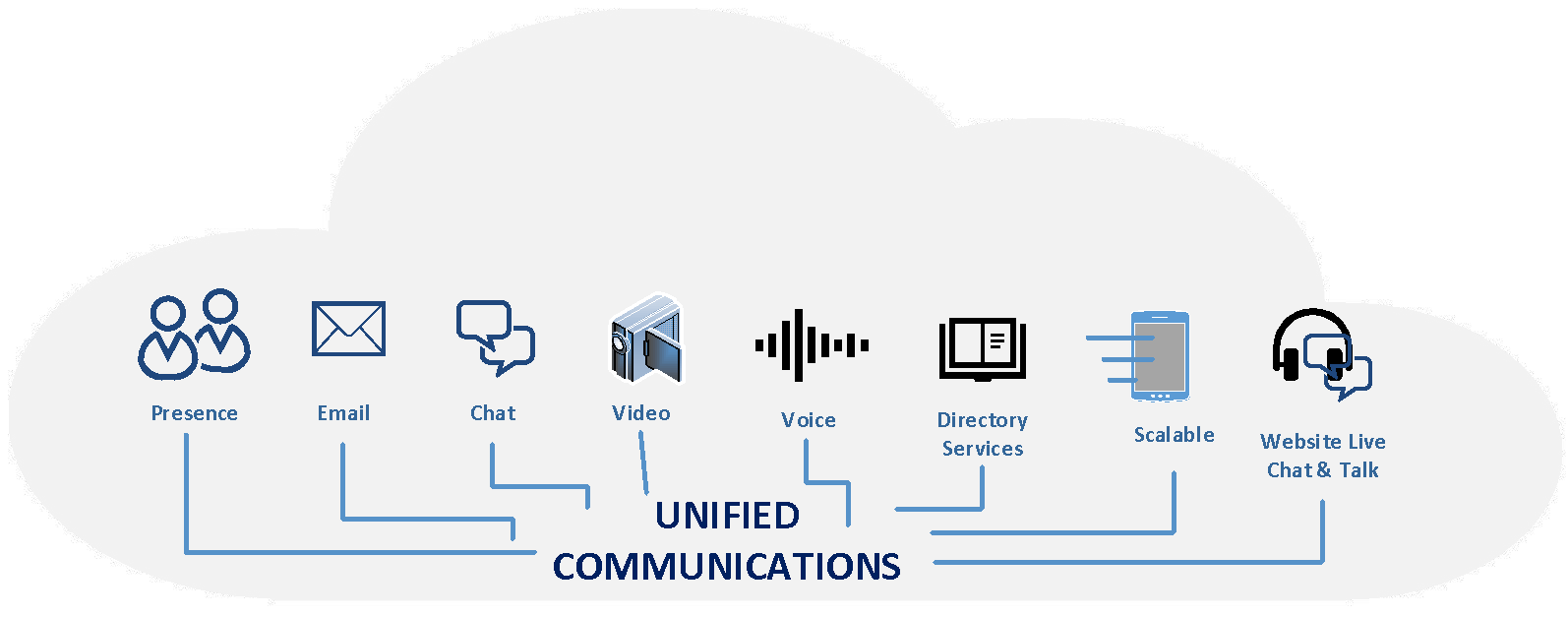
UCaaS improves team communications and collaboration using connectivity from anywhere, anytime, over a variety of devices. UCaaS is very similar to hosted UCS, but with one major distinction: UCaaS is a cloud service. As a cloud service, any UCaaS offering must include the five essential characteristics of a “cloud service” as defined in NIST SP 800-145 and EIS contract Section 2.5 Cloud Services. The “cloud service” requirements are very specific and are covered below.
On-Demand Self-Service: Provides the ability to select and provision services as needed.
Broad Network Access: Provides universal access to thin or thick client platforms like mobile devices and laptops.
Location Independent Resource Pooling: shared computing resources serving multiple consumers.
Rapid Elasticity: Provides the ability to immediately scale up or down based on user needs and peak demands.
Measured Service: Provides the ability to pay only for used services.
One of the highlights of UCaaS is how it enables a business to combine independently run communications subsystems without the major capital investment or additional resources for engineering or new network management responsibilities. UCaaS supports a common user interface for entity communications subsystems, such as VoIP-based/enabled subsystems and applications, including unified messaging, instant messaging, presence, voice mail, integration with email where applicable, fax, and video/ audio/web conferencing, and allows users to access systems and information regardless of location.
Technical Specifications
UCaaS delivers various capabilities over a single platform that seamlessly integrates multiple communications services to enhance personnel’s ability to communicate, collaborate, and exchange information. UCaaS offers the following core capabilities:

Voice and Telephony – UCaaS offers more than voice functionality and works well with a range of softphones and desk phone solutions. UCaaS can provide access to call analytics, call forwarding, routing, and tracking tools.
Conferencing (audio, web, and video) – UCaaS meets the growing demand for more advanced conferencing capabilities. The top providers offer added features such as in-build scheduling options, virtual backgrounds, and digital whiteboarding.
Instant messaging and presence – Messaging is more popular today than ever, and UCaaS offers web access—and mobile-based applications, expanding team collaboration beyond the desktop. UCaaS can support Short Message Service (SMS) and Multimedia Messaging Service (MMS). Added features may include timed messages, @mentioning, privacy, and real-time presence insights.
Cloud-based hosting – UCaaS allows agencies to move away from the burdens of on-premise UC to the cloud provider. An agency may retain certain functions or data redundancy for more sensitive functions or information.
Collaboration Tools – Most UCaaS solutions provide collaboration tools, employee synchronization, presence, and project management applications. UCaaS file storage platforms are also available, allowing document and knowledge sharing and providing real-time co-editing capabilities.
Mobility and Applications – UCaaS solutions are becoming more flexible, offering mobile options, easier access to Application Programming Interfaces (APIs) for developers, and built-in integration capabilities with partner tools.
Unified Communications Interface – UCaaS provides streamlined access to multiple forms of enterprise communications through a single interface.
Communications-enabled business processes – UCaaS provides methods of embedding automated communications into an existing business process through APIs that facilitate the exchanges between two systems.
Management Tools – UCaaS offers comprehensive cloud-based management tools that enable staff with embedded provisioning capabilities, the ability to update technology, or even track the health and quality of the communications systems from anywhere. This core component of UCaaS also enables application integration capabilities, zero-touch provisioning of tools, end-to-end device monitoring, and resource sharing. Any UCaaS solution must also meet all federally required security standards for Cloud services, including FedRAMP and Trusted Internet Connection (TIC) requirements.
UCaaS offerings typically have three main components:
Application servers run by UCaaS providers in their data centers, hosted in third-party data centers, or hosted on public cloud platforms, such as Amazon Web Services (AWS), Google Cloud, or Microsoft Azure;
Downloadable software clients onto user devices or accessed via web browsers using WebRTC
or a plugin; and
Customers access their UCaaS provider via the public Internet or private Wide-Area Network (WAN) links using endpoints such as phones, videoconferencing, and whiteboards.

Companies can bring UCaaS online relatively easily compared to on-premises alternatives, as no complex hardware installation is necessary. UCaaS, which fosters business agility, also enables organizations to shift IT staff away from tedious tasks around siloed, legacy communications platforms to more strategic roles that directly help the business. Most important, however, are employee benefits, including improved collaboration and productivity.
The emerging UCaaS Technologies are:
1. Integrated team Messaging
Most UCaaS providers have made team messaging the centerpiece of UX, and for many companies, team messaging is now the primary collaboration UI. Metrigy research data showed that nearly 68% of companies have rolled out team messaging, with 53% viewing it as a hub for work.
2. Generative AI
UCaaS vendors are adding Generative AI features to their products, driven by the buzz around ChatGPT. These AI-driven features include intelligent note-taking, transcriptions and meeting summaries, content creation and the ability to query, from within an UCaaS interface, data stored in other applications. Some vendors also make it possible to query the public ChatGPT directly from within their UCaaS platform. Generative AI is a fast-moving space, so look for additional collaboration features to emerge over the coming months.
3. Contact center integration (CCaaS)
Almost 74% of research participants are integrating their contact center and UCaaS platforms to simplify management, reduce costs and improve customer service. Those who have already done so are seeing measurable benefits, including an 11.6% improvement in customer ratings, a 7.7% reduction in operational costs and a 13.7% improvement in agent efficiency, according to the Metrigy research. Delivering an integrated UCaaS and contact center experience (CCaaS) gives agents much more flexibility in communicating with subject matter experts and with back-office personnel, enabling them to
quickly resolve customer inquiries.
4. Improved performance
About 45% of employees, on average, work remotely — either full or part time. For many, making a phone call or joining a video meeting requires connecting into the enterprise network through a VPN, which introduces delay and potential performance issues. In an UCaaS environment, remote employees can access the UCaaS provider through their local internet connection, typically improving voice and video performance. Metrigy research participants cited better work-from-home support as their second biggest driver for adopting UCaaS.
5. Application integrations
Most UCaaS vendors make it easy for customers to obtain off-the-shelf plugins that enable seamless integration with other apps used within their organizations. Examples include the ability to integrate project and workflow management into meetings and team spaces and support for third-party whiteboard apps for ideation.
Many UCaaS providers offer APIs, and they also distribute low-code/no-code tools that can be used to create custom integrations. What’s more, it’s not just about integrating apps into the UCaaS UI; most UCaaS providers also enable customers to embed UC features, such as calling and messaging, directly into apps like CRM and email.
6. Integrated text messaging
Many UCaaS providers offer SMS text messaging integrations as part of their calling feature set, enabling employees to use their business numbers for texting. This also lets organizations capture texts for compliance purposes or for integration with CRM platforms. It also serves as a safeguard to prohibit employees from using their personal mobile numbers for business texting.
7. Mobility
UCaaS providers have long offered mobile applications, through which users can make calls, attend meetings or send messages from their personal or company-provided mobile devices. Now, UCaaS providers are beginning to offer fixed mobile convergence options to enable the use of the native dialer — and, in some cases, the native messaging app — for business communications.
Through services such as Microsoft Teams Phone Mobile, Webex Go and RingCentral’s partnership with Vodafone, a mobile device can be configured to essentially act as a fully featured phone extension. Users then don’t have to access the UCaaS app on their phones to place or receive calls. These services are still new, and there are still wrinkles to be ironed out in how they support U.S.-mandated emergency location and notification requirements. But they represent another way in which UCaaS can boost employee productivity, especially for those workers whose roles are dependent on mobile devices as their primary means of communication.
8. Communication Platforms as a Service (CPaaS)
These UCaaS features can help companies boost their productivity, but they aren’t an exhaustive list. Evaluate UCaaS providers to see if they can support these capabilities — as well as others that may be on their roadmap — to help your organization get more value from its UC investments